Hoysaleshwara temple of Halebeedu:
Some Facts about Halebeedu: Halebid or Halebeedu was the 12th century capital of Hoysala Empire. Halebeedu is a Kannada word meaning “Ruined city”, this name is given because this city was ruined two times by Bahamani Sultanate. It was previously called as Dwarasamudra.
There are three main temples in Halebeedu, of which the Hoysaleshwara temple is the largest among all the Hoysala temples, and the most beautiful and important in Halebeedu. The other two are Parshwanatha Jain Basadi and the Kedareshwara temple. There is a lake Dwarasamudra behind these temples, the town gets its name from the lake.
 |
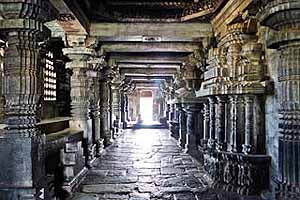
| Inside the Hoysaleshwara temple |
Back to travelogue: Just like Belur, Halebeedu also have a lot more to discover, so it is again not possible to direct whole in a single post, so I’ll be writing it in four posts, the first one for Hoysaleshwara temple, friezes and interiors, second post I’ll be posting about its sculptures and its entrance, third will be for its Nandi mandapa’s and the temple complex. The last one I’ll be posting on the Kedareshwara temple and the Jain Basadi.
After driving about 16 km from Belur we reached Halebeedu town and we first had our lunch at Hotel Mayura in front of the Hoysaleshwara temple. There are shops here also selling the same kind of stuffs which we saw in Belur. Had some tender coconut and entered the Hoysaleshwara temple, at about 3pm. Here also there is no ticket to enter the temple, unlike Belur Chennakeshava temple there is no fee for camera also in Halebeedu temples, but there is a nominal charge for parking set by the locals. The temple looks very huge right from the gates, and the whole area is well maintained by the Govt with lawns and garden area all around. There are a number of guides available here, which we opted for about 200Rs, who took us all around the temple detailing each and every sculpture in the temple.
“While Belur Chennakeshava temple is highlighted on its interiors and the Madanikas, Hoysaleshwara temple is more to watch out on the exteriors and the Ornaments.”
 |
| View on the west side |
Hoysaleshwara temple is famous for its stunning sculptures on its temple walls.
Some facts about Hoysaleshwara temple: The Hoysaleshwara temple dating back to 1121 C.E., was built by Ketamalla and attributed to king Vishnuvardhana, additions were made during the reigns of kings Narasimha I and Ballala II. Then it was invaded by the armies of Malik Kafur in the early 1310 A.D, after which it fell into a state of disrepair and neglect. This magnificent temple was never completed, despite 86 years of labor. However a number of sculptures in the temple are destructed by invaders. So the temple is incomplete. This temple is now being proposed as UNESCO World Heritage Site.
The sculptors who created this beautiful temple were Kalidasa, Damoja, Ketana, Ballana, Revoja, Harisha, and others.
 |
| View of the sculptures on the walls of Hoysaleshwara temple |
Temple Plan: The temple is laid out on a double plan (Dvikuta Vimana or two shrined), almost as if two temples were joined side to side. It enshrines Hoysaleshwara and Shantaleshwara, named after the temple king Vishnuvardhana Hoysala and his wife Queen Shantala Devi. The temples enshrine Shiva lingas, and many of the sculptures are Shaiva, unlike Belur Chennakeshava temple, although Vishnu images and themes are also present. Both shrines open to the east, and rest on the usual Hoysala star-shaped bases (platform or Jagati). There are no gopuras or towers. The two shrines have a Mantapa (Hall) in front, and are connected giving a large and imposing view of the Hall. Individually these are smaller compared to the shrine in the Chennakeshava temple of Belur.
There are two Nandi statues which are on the side of the Hoysaleshwara temple are monolithic. Soap stone or Chloritic Schist (also known as the potstone) was used for the construction of these temples. There is an archeological museum inside the temple campus.
 |
| Hoysaleshwara temple |
The overall effect of the vertical and horizontal lines, the play of the outline, the effect of the light and shade and the plan of the projections and recesses all amounts to a “marvelous exhibition of human labor to be found even in the patient east and surpasses anything in Gothic art”.
The two towers of the shrines that are missing must have followed the star shape of the shrine, just as in many existing well-preserved towers in other Hoysala temples.
 |
| Hoysaleshwara temple |
 |
| Array of sculptures, count on them! They are of 14!! |
 |
| East side view of the temple |
 |
| view from the north side of the temple |
 |
| The walls of the temple were of a perfect pattern |
 |
| The star shaped platform and the temple in sync |
 |
| One more zig-zag structure around the wall of the temple, this is basically a shrine which opens up inside the temple |
Back to the Travelogue: as we entered the temple we were much exited to see countless sculptures on the walls of the temple, these outer walls of the temple contains an intricate array of stone sculptures, which is for it is more popular. The whole temple looks as if it is double the size of the Belur Chennakeshava temple both in area and in height, providing the architects sufficient horizontal and vertical space to depict large and small sculptures. To go through these sculptures in detail one needs at least a day, but we were had planned for a few hour tour here, so it was not at all sufficient to see the entire temple. Now you can imagine the vastness of the temple.
 |
| The main entrance, view from the south side |
 |
| Hoysaleshwara temple |
We first decided to go by the pradakshina patha. The south entrance was the main entrance initially which is more beautifully sculptured compared to the present day entrance in the north side. There are sculptures starting with an image of Dancing Ganesha on the left hand side of the south entrance (original main entrance) and ending with another image of Ganesha on the right hand side of the north entrance (current main entrance). So in-between these two are about 240 such images of both Shaiva and Vaishnava images beautifully sculptured.
 |
| The perforated windows between the pillars on top of the friezes |
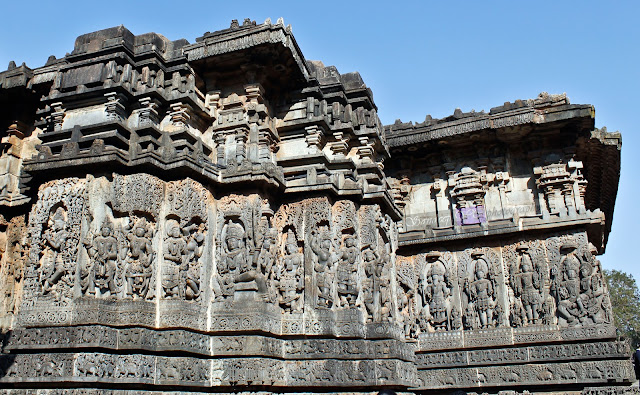 |
| Series of sculptures on the walls of the temple, leaving behind no space untouched |
 |
| One more view of the west side of the temple with small shrines |
 |
| Friezes on the base of the temple on the zig-zag structure |
Interiors of Hoysaleshwara temple:
The interiors of Halebeedu temples are not as beautiful as that of Belur Chennakeshava temple, but the main hall is larger in size.
It consists of two Garbhagrihas with Dwarapalakas on either side of both the shrines. Each of these Dwarapakas have a female attendants. All the four dwarapalakas and their four female attendants are life size and are sculptured from black granite, dominated by beautiful ornaments.
The lintels of both the Shrines have been completely ornate sculptured, both the Garbhagriha's have Shiva Linga's. Regular pooja is carried out in the Hoysaleshwara shrine.
One more interesting feature is infront of both of these shrines there are four central pillars with beautiful ornate ceilings on top, and madanikas on top of the pillar. Among the pillars, these central pillars are the only ones here to watch out for.
Here i leave out the pictures to tell you more about the interiors of the temple.
 |
| The space to the doorways |
 |
| The pillars inside the temple, the ceilings all through this way has beautifully carved sculptures on them |
 |
| The Light and Shadows playing hide and seek inside the temple |
 |
| The small shrines which protrude outside the temple has small entrance doors from here |
 |
| The ceilings in front of one of the main shrines, Here you can see the elephant at the center |
 |
| The ceilings in front of the other main shrine, This one is more highlighted with the gods. Brahma, Vishnu, and Shiva at the center, along with Ganesha in the top right corner. |
 |
| Complete view of the ceilings in front of the other main shrine |
 |
| The only place where the Madanikas are found in this temple are on the central pillars in front of the two main shrines. Most of them being damaged to extent and many missing |
 |
| The carvings on the lintel of one of the dorrways of the main shrine |
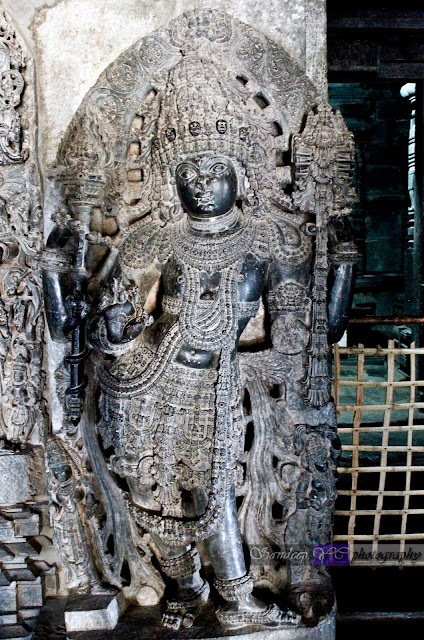 |
| Dwarapalaka on the left side of the Shantaleshwara shrine. There are dwarapalakas like this one on both the sides of the Garbhagriha |
 |
| Dwarapalaka on the right side of the Shantaleshwara shrine. You can see one more female sculpture next to these dwarapalakas |
 |
| Dwarapalaka on the left side of the Hoysaleshwara shrine |
 |
| Female attendant behind the Dwarapalaka on the left side of the Hoysaleshwara shrine |
Walls of the temple:
The walls of the temple is of same plan as of Belur temple, the base of the temple walls comprise of moldings with friezes that comprise of (from bottom to top) elephants, lions, floral scrolls, horses, floral scrolls, puranic scenes, mythical beasts (makara) and swans (hamsa bird), followed by miniature sculptures of music and dance and others, which cover the entire base of the temple walls followed by the large images of gods and goddesses and Madanikas above these.
 |
| The friezes right from the entrance of the temple, with elephants and lions, below the small model shrines |
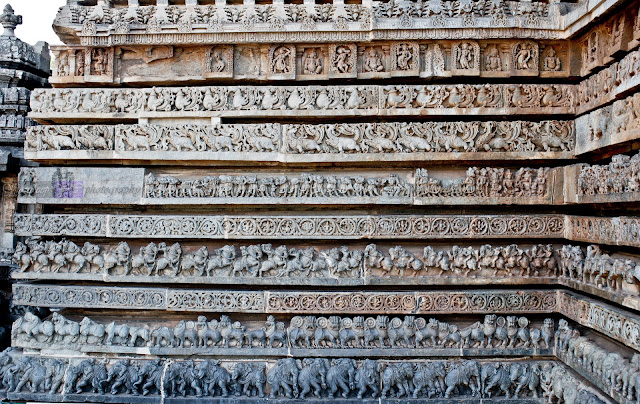 |
| Here you can see most of the friezes have been damaged over time. |
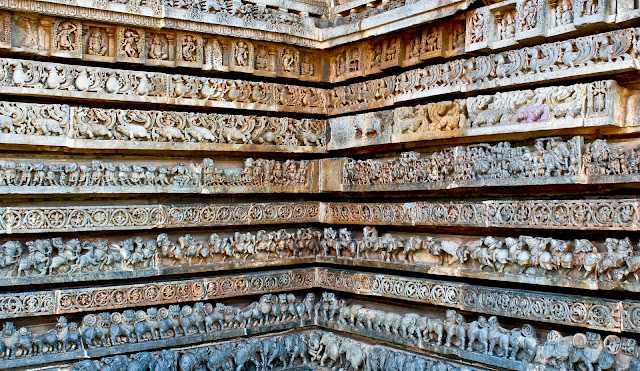 |
| Similar to that of Belur temple, the first three rows carries Elephants, Lions and Horses |
 |
| Small sculptures at the higher rows of the friezes |
 |
| There are about 1248 of these elephants on the base of the temple wall, each one carved uniquely |
 |
| The view of the friezes at the zig-zag structure of the temple walls, here you can see the row above the horses consists of tales and scenes from Indian epics |
 |
| Elephants and lions on the first two rows followed by the floral designs and then the almost ruined horses, followed by another row of floral designs and then the episodes of Ramayana and Mahabharata, on the topmost row it must be kings riding the Makaras . |
 |
| part view of the friezes well structures on the star shaped structure with large recesses in between |
 |
| close up one more set of sculptures on the top rows of the wall friezes |
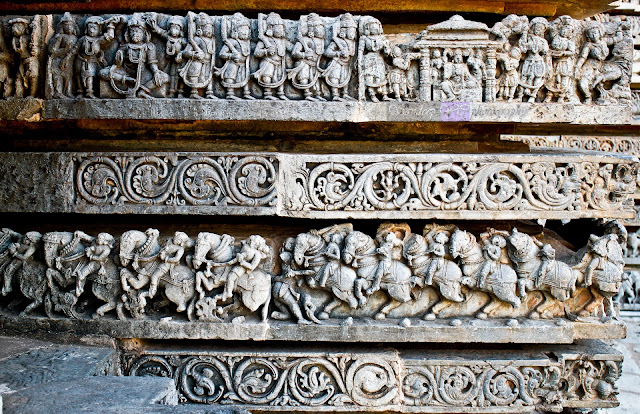 |
| Horses on the lower row with horse riders in different poses, and the scenes of Indian epics on the upper row |
 |
| Sculptures of war scenes on the friezes |
 |
| A scene from Mahabharata sculptured on the friezes |
 |
| sculptures of gods on the friezes, Trimurthi at the center. And makara on top of it. |
Most beautiful feature of the temple were its large Sculptures on the walls which i'll be writing in the next post
Sculptures and doors of Hoysaleshwara temple...To be continued...