Showing posts with label Friezes. Show all posts

Monday, January 28, 2013

Kedareshwara temple and Parshwanatha Jain Basadi of Halebid


Kedareshwara temple and Parshwanatha Jain Basadi of Halebidu:

Kedareshwara temple:
It was about 5 pm before we headed out of the temple towards the Kedareshwara temple which is just 500 m away from the Hoysaleshwara temple.
Star shaped structure of the Kedareshwara Temple
According to the inscriptions, it was built by Hoysala king Ballala II and his queen Abhinava Ketaladevi in 1219 A.D. Some parts of this temple had been destroyed and some reconstruction work has been taken place in this temple. In-spite of this, the temple has retained most of its originality and presents a good view of a typical Hoysala Temple.
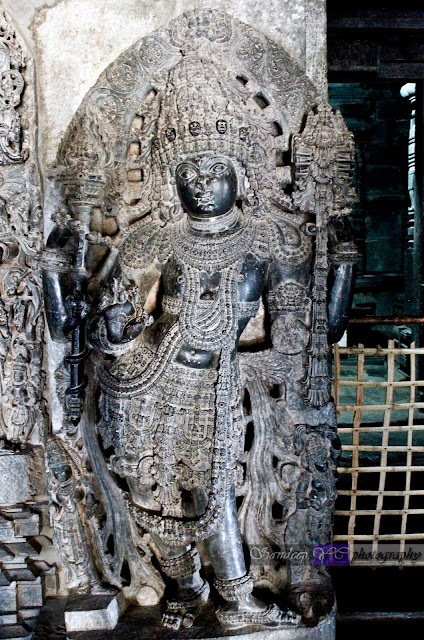
Image of shiva-parvati on the walls of the temple
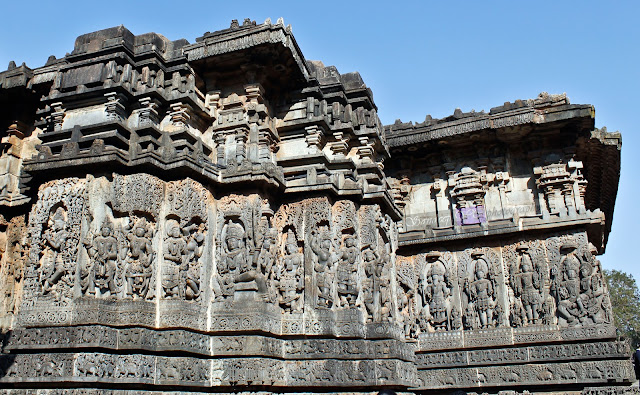
Friezes and the sculptures on the walls of the Kedareshwara temple
Built with soapstone, stands on a platform of sixteen points and the super structure are parallel to the contour of the platform. Originally this was a trikuta or three celled temple but all the garbhagrihas are now empty. As a feature of Hoysala architecture the base of the temple wall has horizontal friezes with the scenes depicting stories from Ramayana, Mahabharata and Puranas.  Above these friezes are the sculptures of Gods and Goddesses, shown under ornamented and intricately carved canopies.
View of the temple, with raised platform and perforated pierced windows
Interiors have lathe turned pillars and minutely carved bhuvaneshvaris (Ceilings). The sikhara which once adorned the southern garbhagriha is now missing.

The temple is destroyed to extent and further to protect this temple the door was closed, so just can have a glance from the temple door.
Inside the temple, as seen from the locked door
Not waiting further we headed towards our last destination the Jain Basadi, since it could get closed as it was already 5.15 pm.

Jain Temples of Halebid:
Further way back just behind the Hoysaleshwara temple are the group of Jain Temples, three at present. This reflects the religious tolerance of the Hoysala's who patronized all the major contemporary sects like Saivism, Vaishnavism and Jainism. The three Jain temples in a row are dedicated to Parsvanatha (west), Adinatha (central), and Shantinatha (east) tirthankaras.

Parshvanatha Basadi: The first temple at the west to the present entrance of the complex is the Parsvanatha Basadi. This temple was built by Boppana, the son of the famous Gangaraja who was a minister under Hoysala King Vishnuvardhana. This temple was built in the year 1133 A.D., in the memory of Gangaraja by his son.

This Basadi is built of soapstone and consists of a garbhagriha, a sukhanasi, a navaranga and a detached mukhamandapa. The pillars of the mukhamandapa are not polished but are beautifully ornate.
The pillars of the mukhamandapa outside the Parshvanatha Basadi
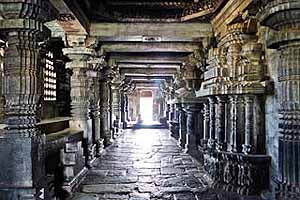
The square garbhagriha and the walls of the navaranga are plain but decorated with pilasters at intervals. The lathe turned and elegant twelve pillars in the navaranga are highly polished with mirror-like glossy surface. The ceilings had small sculptures on it but it was totally dark, so not visible properly.
The lathe turned pillar in the main hall
Ornate Pillars inside the Navaranga (main hall)
Beautifully turned pillars with mirror like finish and amazing designs
The most important attraction of this temple is the 18 ft. tall Parsvanatha Tirtankara statue in the garbhagriha (sanctum). This sculpture with a seven hooded serpent over his head represents a perfect yogi or a realized soul with a benign and sympathetic smile on his lips. Such Jain sculptures are rare.
Parshwanatha tirtankara statue, with 7-head serpent behind
The whole temple was so dark that I was blindly keeping my bare foot ahead, it was getting further darker towards the garbhagriha, there are no windows for this temple, the only light source being the tall entrance door of the temple, it was of the same height as the statue inside, there were no lights inside the temple, the light from the door directly falls on the Parsvanatha statue.
The light source from the door to the garbhagriha
Play of Light and Shade inside the temple
10 of the 12 elegantly carved pillars of the navaranga, Parshvanatha statue at the center, and the ceiling sculptures partially visible through the door.
10 of the 12 elegantly carved pillars of the navaranga, Parshvanatha statue at the center, and the ceiling sculptures partially visible through the door.
Kannada inscriptions outside the temple
The doorjamb of the Parshvanatha temple

 Shantinatha Basadi: Almost similar to the above but of lesser dimensions is the Shantinatha Basadi. It was built around 1192 A.D., during the reign of Ballala II. Its temple plan is similar to that of the Parsvanatha temple, it consists of a garbhagriha, sukhanasi, a navaranga and a mandapa. The mandapa must have been added later during the Vijayanagara period. The garbhagriha has a fine image of Shantinatha tirtankara which is also about 18 ft. in height. In between these two basadis, is another smaller one, the Adinatha Basadi, built in 1138 A.D., by minister Mallayya during the reign of king Vishnuvardhana.


We finally left the Halebeedu and the clock was ticking 5.45 pm and before the darkness falls thought to reach the NH48.

We halted for our dinner at hotel Swathi Delicacy which was newly built and the service of the restaurant must be appreciated. We concluded the trip reaching Bangalore by 11.30 pm, well not just another trip but one of the most beautiful pleasure for our eyes and definitely a must visit for everyone, and I bet you can’t just visit only once ;-)

Hoysaleshwara temple Nandi Mandapas and the Temple complex

Hoysaleshwara temple Nandi Mandapa’s and the Temple complex:


Nandi Mandapa's:
To the other side of the temple to the east are two more entrances facing to the Dwara Samudra Lake and to both of these east doors are the Nandi Mandapa's built with huge Nandi (the Bull, an attendant of Lord Shiva) statues inside it, being majestic in appearance and beautiful in composition. The walls on this side are more or less plain with less number of sculptures and pillars holding the roof structure and pierced perforated window structures are placed similar to that of the Belur temple.
Nandi Mantapa 1
Nandi Mantapa 1
The first Nandi statue from the north is of more importance and is more beautifully carved than the other. It has a plain mantapa with pillars and open to air without any walls, it doesn’t have a garbhagriha, but has model shrines on either sides of the Nandi mantapa.
Friezes on the base of the Nandi Mantapa 1, beside it is the Nandi Mantapa 2
Friezes on the base of the Nandi Mantapa 1, beside it is the Nandi Mantapa 2
Side view of the Nandi Mantapa 1
Pillars of the Nandi Mantapa 1
The more beautiful and ornate of the two Nandi statues at the Nandi Mantapa 1
The second Nandi mantapa is larger than the first one, similar to the first one it also has two model shrines on wither sides of the entrance and stands on a number of pillars with open structure, the only difference is this has a garbhagriha (sanctuary) with a beautiful Surya (Sun god) idol, carved out of black stone. The image of the Sun god Surya stands 7 ft. (2.1 m) tall.
Nandi Mantapa 2 with a shrine of Sun God behind Nandi statue
Pillars of Nandi Mantapa 2
Nandi statue at Nandi Mantapa 2, this was larger than the first one
Sun God statue Beautifully carved from black stone, it was totally dark inside the shrine
Sun God statue Beautifully carved from black stone, it was totally dark inside the shrine
An 8 feet tall sculpture of Ganesha including the platform rests at the south entrance, away from the temple platform.
Ganesha statue
Ganesha statue
Archaeological Museum of Halebid:
The museum was established in the early part of 1970’s. This museum has more than 1500 sculptures, architectural members; inscriptions of historical significance retrieve in and around Halebidu. The collection is displayed in a closed sculpture gallery as well as in an open air museum with a large reserve collection. It also display 18 ft. Tirthankara image from the ruined tank of one of the Jaina basadis.
Tall Jain sculpture at the museum
The open air museum has in its display many sculptures of importance like Govardhana giridhari Krishna, dancing Shiva, Nataraja and Veena Saraswati, dancing Ganesha, elegant couchant Nandi to name a few. The Sculptures of Brahma-Saraswati, Nagna Kala Bhairava, Mother and Child, wooden carvings and a bronze statue of a Tirthankara have been the important display in the sculpture gallery. The master pieces of this museum have represented Indian art in the various exhibitions held at France, Japan and other countries.

Opening Hours: 10.00 am to 5.00 pm
Closed on – Friday
Entrance Fee: Rs 5/- per head (Children up to 15 years free)

******************************************************************************** 

After visiting this temple one would have to imagine, how would have this temple be 800 years ago when it was constructed with its twin towers on top of the roof, it must be surely a marvelous structure, making it feel jealous for the foreigners to invade it twice, and many sculptures of the temple have been stolen and few of them taken to western countries, making it incomplete as its whole, otherwise the glory of the temple would have been enormous.


Though the temple was repeatedly ruined by the enemy kings of those days, I liked the whole temple being protected today by the government (or the Archeological survey of India), there were about 50 labors being employed for safe guarding the temple, and also they won’t even allow you to touch the walls of the temples, which should be pretty must appreciated. I personally feel they are the rare history of humankind and must be protected for generations to come; best way is to grant it as a UNESCO world heritage site for its rarest kind of man made marvels. If building huge structures is one kind of man made marvel then building a cutting edge quality structures carved entirely out of stones and lasting about 900years even after ruined by so many rivals, is another kind of man made marvel, some of them are so intricate that even with the present day machines it is pretty much difficult to even attempt to construct these kind of sculptures. Instead of granting world heritage sites for less meaningful and recently constructed structures, UNESCO should more concentrate on protecting the ancient structures in the process of protecting the history of mankind.


Kedareshwara temple and Parshwanatha Jain Basadi...To be continued...


Wednesday, January 23, 2013

Hoysaleshwara temple of Halebeedu


Hoysaleshwara temple of Halebeedu:

Some Facts about Halebeedu: Halebid or Halebeedu was the 12th century capital of Hoysala Empire.  Halebeedu is a Kannada word meaning “Ruined city”, this name is given because this city was ruined two times by Bahamani Sultanate. It was previously called as Dwarasamudra.
There are three main temples in Halebeedu, of which the Hoysaleshwara temple is the largest among all the Hoysala temples, and the most beautiful and important in Halebeedu. The other two are Parshwanatha Jain Basadi and the Kedareshwara temple. There is a lake Dwarasamudra behind these temples, the town gets its name from the lake.
Inside the Hoysaleshwara temple
Inside the Hoysaleshwara temple
Back to travelogue: Just like Belur, Halebeedu also have a lot more to discover, so it is again not possible to direct whole in a single post, so I’ll be writing it in four posts, the first one for Hoysaleshwara temple, friezes and interiors, second post I’ll be posting about its sculptures and its entrance, third will be for its Nandi mandapa’s and the temple complex. The last one I’ll be posting on the Kedareshwara temple and the Jain Basadi.

After driving about 16 km from Belur we reached Halebeedu town and we first had our lunch at Hotel Mayura in front of the Hoysaleshwara temple. There are shops here also selling the same kind of stuffs which we saw in Belur. Had some tender coconut and entered the Hoysaleshwara temple, at about 3pm. Here also there is no ticket to enter the temple, unlike Belur Chennakeshava temple there is no fee for camera also in Halebeedu temples, but there is a nominal charge for parking set by the locals. The temple looks very huge right from the gates, and the whole area is well maintained by the Govt with lawns and garden area all around. There are a number of guides available here, which we opted for about 200Rs, who took us all around the temple detailing each and every sculpture in the temple.

While Belur Chennakeshava temple is highlighted on its interiors and the Madanikas, Hoysaleshwara temple is more to watch out on the exteriors and the Ornaments.”
View on the west side
Hoysaleshwara temple is famous for its stunning sculptures on its temple walls.

Some facts about Hoysaleshwara temple: The Hoysaleshwara temple dating back to 1121 C.E., was built by Ketamalla and attributed to king Vishnuvardhana, additions were made during the reigns of kings Narasimha I and Ballala II. Then it was invaded by the armies of Malik Kafur in the early 1310 A.D, after which it fell into a state of disrepair and neglect. This magnificent temple was never completed, despite 86 years of labor. However a number of sculptures in the temple are destructed by invaders. So the temple is incomplete. This temple is now being proposed as UNESCO World Heritage Site.
The sculptors who created this beautiful temple were Kalidasa, Damoja, Ketana, Ballana, Revoja, Harisha, and others.
View of the sculptures on the walls of Hoysaleshwara temple
Temple Plan: The temple is laid out on a double plan (Dvikuta Vimana or two shrined), almost as if two temples were joined side to side. It enshrines Hoysaleshwara and Shantaleshwara, named after the temple king Vishnuvardhana Hoysala and his wife Queen Shantala Devi. The temples enshrine Shiva lingas, and many of the sculptures are Shaiva, unlike Belur Chennakeshava temple, although Vishnu images and themes are also present. Both shrines open to the east, and rest on the usual Hoysala star-shaped bases (platform or Jagati). There are no gopuras or towers. The two shrines have a Mantapa (Hall) in front, and are connected giving a large and imposing view of the Hall. Individually these are smaller compared to the shrine in the Chennakeshava temple of Belur.
There are two Nandi statues which are on the side of the Hoysaleshwara temple are monolithic. Soap stone or Chloritic Schist (also known as the potstone) was used for the construction of these temples. There is an archeological museum inside the temple campus.
Hoysaleshwara temple
The overall effect of the vertical and horizontal lines, the play of the outline, the effect of the light and shade and the plan of the projections and recesses all amounts to a “marvelous exhibition of human labor to be found even in the patient east and surpasses anything in Gothic art”.
The two towers of the shrines that are missing must have followed the star shape of the shrine, just as in many existing well-preserved towers in other Hoysala temples.
Hoysaleshwara temple
Array of sculptures, count on them! They are of 14!!
East side view of the temple
view from the north side of the temple
The walls of the temple were of a perfect pattern
The star shaped platform and the temple in sync
One more zig-zag structure around the wall of the temple, this is basically a shrine which opens up inside the temple

Back to the Travelogue: as we entered the temple we were much exited to see countless sculptures on the walls of the temple, these outer walls of the temple contains an intricate array of stone sculptures, which is for it is more popular. The whole temple looks as if it is double the size of the Belur Chennakeshava temple both in area and in height, providing the architects sufficient horizontal and vertical space to depict large and small sculptures. To go through these sculptures in detail one needs at least a day, but we were had planned for a few hour tour here, so it was not at all sufficient to see the entire temple. Now you can imagine the vastness of the temple.
The main entrance, view from the south side
The main entrance, view from the south side
Hoysaleshwara temple
We first decided to go by the pradakshina patha. The south entrance was the main entrance initially which is more beautifully sculptured compared to the present day entrance in the north side. There are sculptures starting with an image of Dancing Ganesha on the left hand side of the south entrance (original main entrance) and ending with another image of Ganesha on the right hand side of the north entrance (current main entrance). So in-between these two are about 240 such images of both Shaiva and Vaishnava images beautifully sculptured.
The perforated windows between the pillars on top of the friezes
Series of sculptures on the walls of the temple, leaving behind no space untouched
One more view of the west side of the temple with small shrines
Friezes on the base of the temple on the zig-zag structure
 Interiors of Hoysaleshwara temple:
The interiors of Halebeedu temples are not as beautiful as that of Belur Chennakeshava temple, but the main hall is larger in size. 
It consists of two Garbhagrihas with Dwarapalakas on either side of both the shrines. Each of these Dwarapakas have a female attendants. All the four dwarapalakas and their four female attendants are life size and are sculptured from black granite, dominated by beautiful ornaments.
The lintels of both the Shrines have been completely ornate sculptured, both the Garbhagriha's have Shiva Linga's. Regular pooja is carried out in the Hoysaleshwara shrine. 
One more interesting feature is infront of both of these shrines there are four central pillars with beautiful ornate ceilings on top, and madanikas on top of the pillar. Among the pillars, these central pillars are the only ones here to watch out for.
Here i leave out the pictures to tell you more about the interiors of the temple.
The space to the doorways
The pillars inside the temple, the ceilings all through this way has beautifully carved sculptures on them
The Light and Shadows playing hide and seek inside the temple
The small shrines which protrude outside the temple has small entrance doors from here
The ceilings in front of one of the main shrines, Here you can see the elephant at the center
The ceilings in front of one of the main shrines, Here you can see the elephant at the center
The ceilings in front of the other main shrine, This one is more highlighted with the gods. Brahma, Vishnu, and Shiva at the center, along with Ganesha in the top right corner.
The ceilings in front of the other main shrine, This one is more highlighted with the gods. Brahma, Vishnu, and Shiva at the center, along with Ganesha in the top right corner.
The ceilings in front of the other main shrine
Complete view of the ceilings in front of the other main shrine
The only place where the Madanikas are found in this temple are on the central pillars in front of the two main shrines. Most of them being damaged to extent and many missing
The carvings on the lintel of one of the dorrways of the main shrine
Dwarapalaka on the left side of the Shantaleshwara shrine. There are dwarapalakas like this one on both the sides of the Garbhagriha
Dwarapalaka on the right side of the Shantaleshwara shrine. You can see one more female sculpture next to these dwarapalakas
Dwarapalaka on the left side of the Hoysaleshwara shrine
Female attendant behind the Dwarapalaka on the left side of the Hoysaleshwara shrine

Walls of the temple:
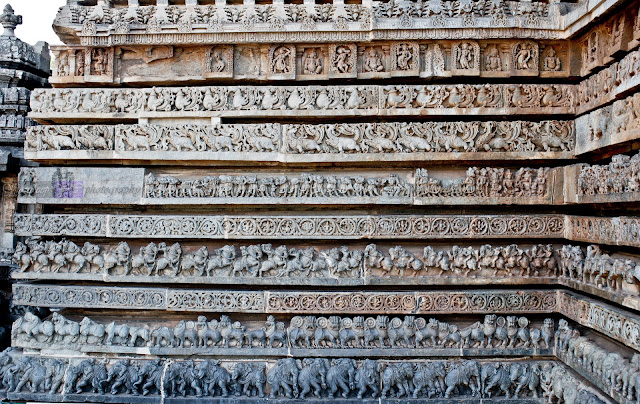
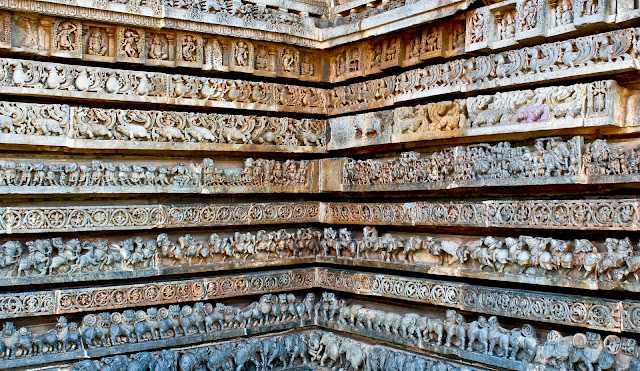
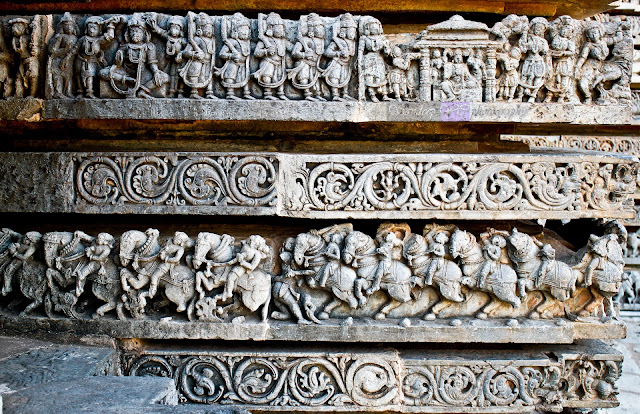
The walls of the temple is of same plan as of Belur temple, the base of the temple walls comprise of moldings with friezes that comprise of (from bottom to top) elephants, lions, floral scrolls, horses, floral scrolls, puranic scenes, mythical beasts (makara) and swans (hamsa bird), followed by miniature sculptures of music and dance and others, which cover the entire base of the temple walls followed by the large images of gods and goddesses and Madanikas above these.
The friezes right from the entrance of the temple, with elephants and lions, below the small model shrines
Here you can see most of the friezes have been damaged over time.
Similar to that of Belur temple, the first three rows carries Elephants, Lions and Horses
Similar to that of Belur temple, the first three rows carries Elephants, Lions and Horses
Small sculptures at the higher  rows of the friezes
Small sculptures at the higher  rows of the friezes
There are about 1248 of these elephants on the base of the temple wall, each one carved uniquely
The view of the friezes at the zig-zag structure of the temple walls, here you can see the row above the horses consists of tales and scenes from Indian epics
The view of the friezes at the zig-zag structure of the temple walls, here you can see the row above the horses consists of tales and scenes from Indian epics
Elephants and lions on the first two rows followed by the floral designs and then the almost ruined horses, followed by another row of floral designs and then the episodes of Ramayana and Mahabharata, on the topmost row it must be kings  riding the Makaras .
Elephants and lions on the first two rows followed by the floral designs and then the almost ruined horses, followed by another row of floral designs and then the episodes of Ramayana and Mahabharata, on the topmost row it must be kings  riding the Makaras .
part view of the friezes well structures on the star shaped structure with large recesses in between
close up one more set of sculptures on the top rows of the wall friezes
Horses on the lower row with horse riders in different poses, and the scenes of Indian epics on the upper row
Sculptures of war scenes on the friezes
A scene from Mahabharata sculptured on the friezes
sculptures of gods on the friezes, Trimurthi at the center. And makara on top of it.

Most beautiful feature of the temple were its large Sculptures on the walls which i'll be writing in the next post

Sculptures and doors of Hoysaleshwara temple...To be continued...