Showing posts with label Hoysaleshwara temple. Show all posts

Monday, January 28, 2013

Hoysaleshwara temple Nandi Mandapas and the Temple complex

Hoysaleshwara temple Nandi Mandapa’s and the Temple complex:


Nandi Mandapa's:
To the other side of the temple to the east are two more entrances facing to the Dwara Samudra Lake and to both of these east doors are the Nandi Mandapa's built with huge Nandi (the Bull, an attendant of Lord Shiva) statues inside it, being majestic in appearance and beautiful in composition. The walls on this side are more or less plain with less number of sculptures and pillars holding the roof structure and pierced perforated window structures are placed similar to that of the Belur temple.
Nandi Mantapa 1
Nandi Mantapa 1
The first Nandi statue from the north is of more importance and is more beautifully carved than the other. It has a plain mantapa with pillars and open to air without any walls, it doesn’t have a garbhagriha, but has model shrines on either sides of the Nandi mantapa.
Friezes on the base of the Nandi Mantapa 1, beside it is the Nandi Mantapa 2
Friezes on the base of the Nandi Mantapa 1, beside it is the Nandi Mantapa 2
Side view of the Nandi Mantapa 1
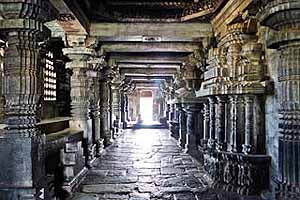
Pillars of the Nandi Mantapa 1
The more beautiful and ornate of the two Nandi statues at the Nandi Mantapa 1
The second Nandi mantapa is larger than the first one, similar to the first one it also has two model shrines on wither sides of the entrance and stands on a number of pillars with open structure, the only difference is this has a garbhagriha (sanctuary) with a beautiful Surya (Sun god) idol, carved out of black stone. The image of the Sun god Surya stands 7 ft. (2.1 m) tall.
Nandi Mantapa 2 with a shrine of Sun God behind Nandi statue
Pillars of Nandi Mantapa 2
Nandi statue at Nandi Mantapa 2, this was larger than the first one
Sun God statue Beautifully carved from black stone, it was totally dark inside the shrine
Sun God statue Beautifully carved from black stone, it was totally dark inside the shrine
An 8 feet tall sculpture of Ganesha including the platform rests at the south entrance, away from the temple platform.
Ganesha statue
Ganesha statue
Archaeological Museum of Halebid:
The museum was established in the early part of 1970’s. This museum has more than 1500 sculptures, architectural members; inscriptions of historical significance retrieve in and around Halebidu. The collection is displayed in a closed sculpture gallery as well as in an open air museum with a large reserve collection. It also display 18 ft. Tirthankara image from the ruined tank of one of the Jaina basadis.
Tall Jain sculpture at the museum
The open air museum has in its display many sculptures of importance like Govardhana giridhari Krishna, dancing Shiva, Nataraja and Veena Saraswati, dancing Ganesha, elegant couchant Nandi to name a few. The Sculptures of Brahma-Saraswati, Nagna Kala Bhairava, Mother and Child, wooden carvings and a bronze statue of a Tirthankara have been the important display in the sculpture gallery. The master pieces of this museum have represented Indian art in the various exhibitions held at France, Japan and other countries.

Opening Hours: 10.00 am to 5.00 pm
Closed on – Friday
Entrance Fee: Rs 5/- per head (Children up to 15 years free)

******************************************************************************** 

After visiting this temple one would have to imagine, how would have this temple be 800 years ago when it was constructed with its twin towers on top of the roof, it must be surely a marvelous structure, making it feel jealous for the foreigners to invade it twice, and many sculptures of the temple have been stolen and few of them taken to western countries, making it incomplete as its whole, otherwise the glory of the temple would have been enormous.


Though the temple was repeatedly ruined by the enemy kings of those days, I liked the whole temple being protected today by the government (or the Archeological survey of India), there were about 50 labors being employed for safe guarding the temple, and also they won’t even allow you to touch the walls of the temples, which should be pretty must appreciated. I personally feel they are the rare history of humankind and must be protected for generations to come; best way is to grant it as a UNESCO world heritage site for its rarest kind of man made marvels. If building huge structures is one kind of man made marvel then building a cutting edge quality structures carved entirely out of stones and lasting about 900years even after ruined by so many rivals, is another kind of man made marvel, some of them are so intricate that even with the present day machines it is pretty much difficult to even attempt to construct these kind of sculptures. Instead of granting world heritage sites for less meaningful and recently constructed structures, UNESCO should more concentrate on protecting the ancient structures in the process of protecting the history of mankind.


Kedareshwara temple and Parshwanatha Jain Basadi...To be continued...


Sunday, January 27, 2013

Hoysaleshwara temple Sculptures and Doorways

Sculptures & Doorways of Hoysaleshwara temple
Sculptures on the walls of the Hoysaleshwara temple
Entrance:
There are totally 4 doorways for the temple out of which the south door is of most importance. The entrance looks similar to that of the Belur, and is a true Hoysala style of architecture, with two model shrines on either sides of the door and the Lintel being exquisitely carved with small sculptures on them.
The south entrance of the Hoysaleshwara temple
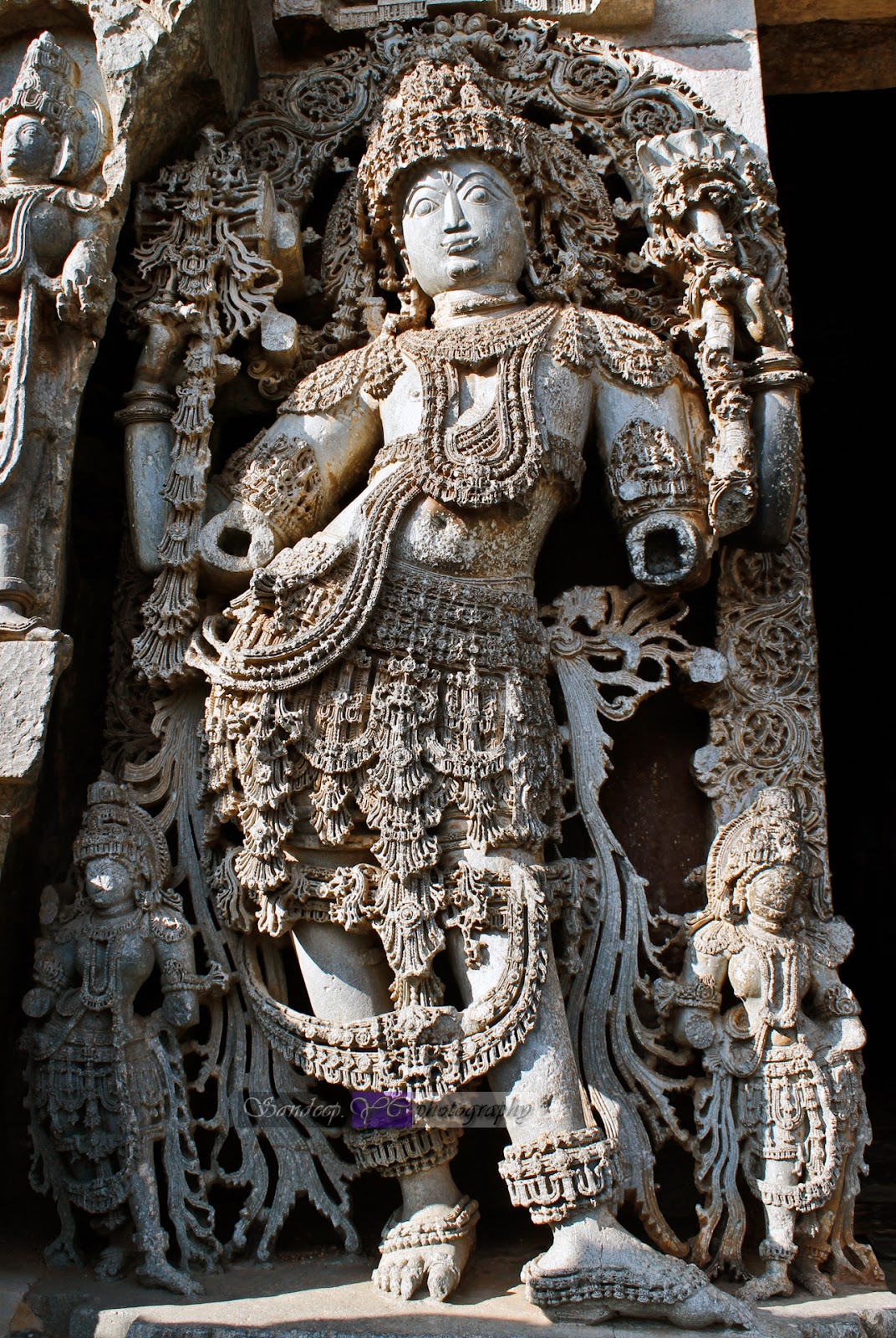
The Dwarapalakas and the lintel work at the south entrance
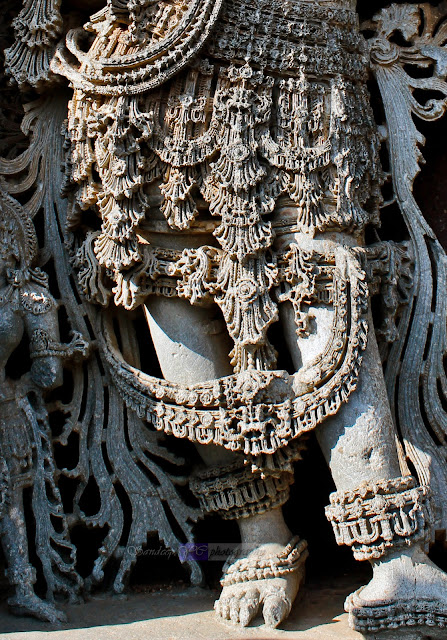
The most beautiful sculpture in Hoysaleshwara temple were the two sculptures of Dwarapalakas at the south door of the temple, it has the most elaborately carved ornaments  on both these sculptures.
Dwarapalaka at the North entrace
Dwarapalaka on the right of the south entrance
Dwarapalaka on the left of the south entrance
Here you can imagine those days how rich and elegant were there ornaments decorated so beautifully
Even today you wont find such a beautiful jewels of gold which were those days carved out of stone
Sculptures:
There are 240 large sculptures on the walls of the temple, out of them the most significant ones being the Shiva and Vishnu images.
The avatars of Vishnu include Varaha, Narasimha, Vamana, and Krishna. And there are many Shiva sculptures found on the walls.


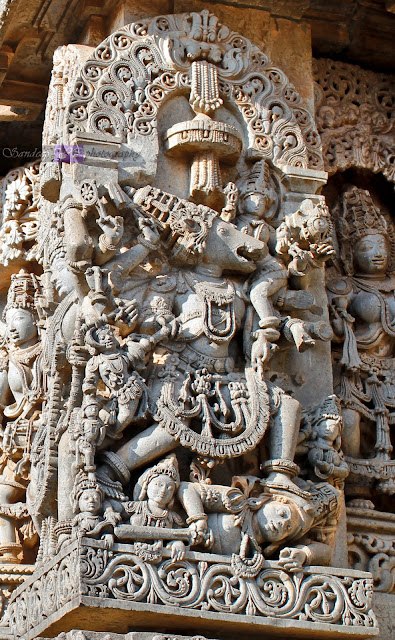
1. Varaha
This relief of Varaha seems to emphasize his fierceness against the conquered demon, rather than his tenderness towards the rescued goddess.
The fineness of the carving, which is deeply undercut and encrusted with ornamentation in the best Hoysala style, is characteristic of most sculptures on the temple.
Varaha
Varaha
2. Narasimha
There were many images of Narasimha out of which im showing you two of them below
Narasimha 1Narasimha 2

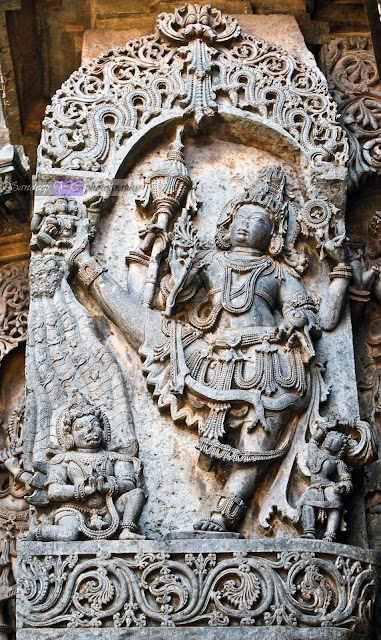
3. Vishnu Trivikrama
Vishnu takes a giant step to reclaim the universe, as Garuda worships to his right. Brahma (with three heads) appears beside Vishnu's right foot, indicating that in this step Vishnu has covered the heavens.
Vishnu Trivikrama
Vishnu Trivikrama
4. Garuda
There were two images of Garuda which i found here. The first one is the Garuda, who as a bird is the traditional enemy of snakes, fights a pair of nagas.
The second one was on another here also you can notice the wings on the left side of the pic.
Garuda fighting with snake
Garuda, you can notice the wings on his right
5. Shiva
Shiva dances powerfully on the body of a demon, which he tramples under foot.

Shiva
Shiva
6. Shiva
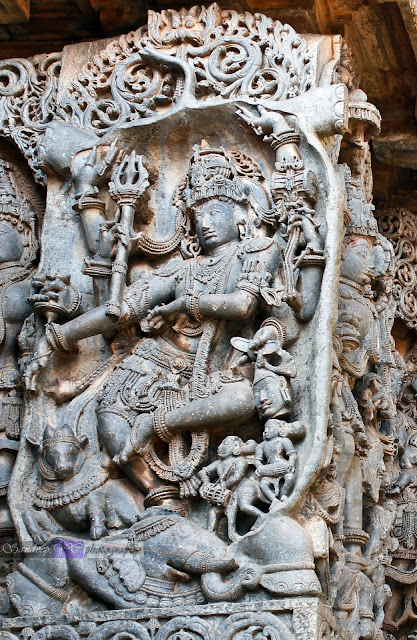
A fierce manifestation of Shiva dancing on a demon. Shiva holds multiple weapons, a snake-entwined skull staff (photo left), and a drum (photo left, above Nandi). A corpse appears to the right edge of the photo. At the upper right of the photo, Shiva spears a small enemy with his trident.

Shiva with Trishul in his hand
7.Shiva & Parvati
The right image is of Shiva Parvati on Nandi
Shiva Parvati Shiva Parvati on Nandi

8. Gajasurasamhara
The Slayer of the elephant demon.The fierce aspect of the Hindu god Shiva as the Destroyer of the elephant demon, Gajasura.
Gajasura 1
Gajasura
Gajasura 2
Gajasura
9. Bhikshatana / Bhairava
This image is a stunning amalgamation of gentle Bhikshatana and fierce Bhairava, both forms of Shiva. The sandals belong to Bhikshatana, the other attributes to Bhairava. In the lower right, two figures seem to represent a Brahmin trying to keep his wife away from Bhikshatana. The figures may be interpreted as emaciated aescetics (Bhikshatana), as corpses (Bhairava), or - as so often in additive cultures like India's - as both. Overall, the fierce expression and imagery of Bhairava clearly dominate this sculpture, which I would characterize as Bhikshatana assimilated into Bhairava.
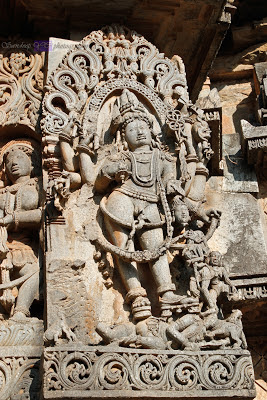
Bhikshatana
Bhikshatana
10. Ganesha
Dancing Ganesha
Dancing Ganesha
Ganesha
Ganesha
11. Lakshmi Narayana
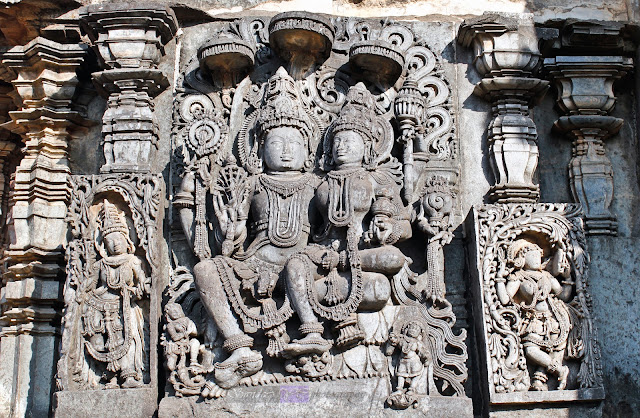
Lakshmi Narayana, also seen here is the most popular madanika style of Belur on the right of the pic
12. Ravana lifting Kailasa

Ravana Lifting Kailasa mountain, Similar to that of the Belur.
So much of details can be seen here, with Shiva - Parvati sitting on Nandi on top of the mountain. 
Ravana Lifting Mount Kailasa
13. Arjuna
Arjuna
Arjuna
14. Durga Mahishasuramardini
Durga, armed with the weapons of all the gods, slays the buffalo demon Mahisha.
Durga Mahishasuramardini
15. Kaali
Kali dances around the graveyard with trident, sword, and severed head. She is adored by attendant corpses. Kali represents Time, which brings all things to ruin.
Kaali
Kaali
16. Trimurti - Brahma, Vishnu and Maheshwara
Trimurthi
Trimurthi
17. Lord Krishna
Lord Krishna
Lord Krishna
18. Govardhana Giridhari
Lord Krishna again......Govardhana Giridhari!! Notice the details of Govardhana Mountain!!

Govardhana Giridhari
19. Saraswati
Sawaswati at the center
20. Madanika under foliage
Shilabalikas under foliage. Notice beautifully sculpted robes of theirs!! 
Shilabalike under foliage
21. Dancing girl under Foliage
Madanika or Dancing girl under Foliage.......can anything be more beautiful and complete than this!!!!!

Madanika or Dancing girl under FoliageMadanika or Dancing girl under Foliage

There was a large panel of sculptures of Gods and Goddesses, seven in total, and i suppose the most unique of them all. All of these images were on top of the wall, unreachable from ground.
Panel of sculptures of Gods and Goddesses, with seven images
The first four of them were, from left, Brahma, Maheshwara, Vishnu, Lakshmi(??)
The last three were Vishnu with Adishesha, Shiva and the last one coudnt recall the name
There was another panel with series of images which includes a madanika also along with the Gods
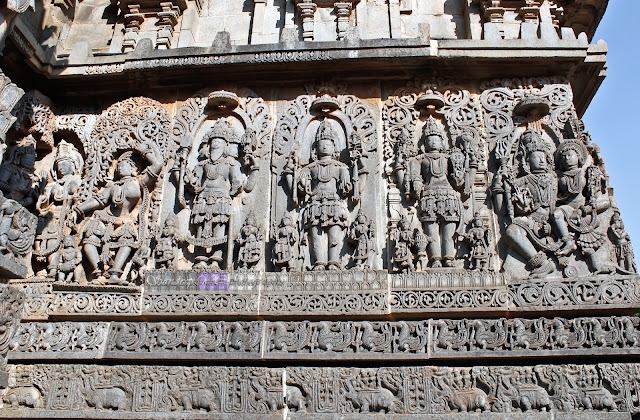
From right Shiva-Parvati, Vishnu, Maheshwara, Brahma, and followed by Madanika in dancing pose
I'm pasting here the rest of the images which i felt were also important...


Some more images of the walls of the temple

Wall Sculptures on the walls of the Hoysaleshwara temple
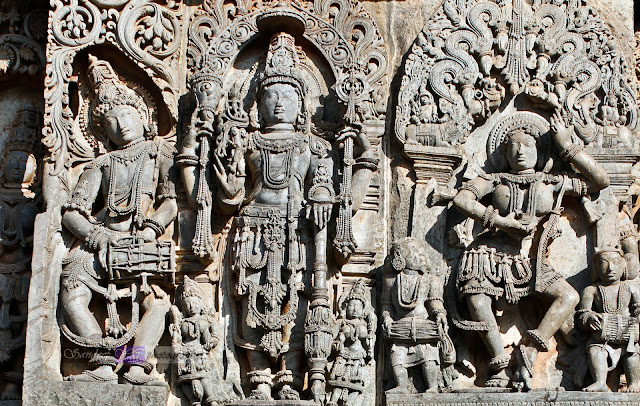
Wall sculptures with drum dancer at the center, here the ropes of the dhol or dholi is carved out of the stone leaving behind hollow sections inside, giving a view of a real Dhol or Hand Drum
The designs on top of the sculptures
On the left is the Dancer with tabla, at the center must be the image of Vishnu, and on the right is a Shilabalike or the dancing madanika
Light and Shade on the Sculptures

Apart from these sculptures there were two Nandi mantapas attached to the temple and an Archeological museum in the campus which i'll be detailing in the following post.

Nandi Mandapa’s and the Temple complex...To be continued...