Showing posts with label Nandi Statue. Show all posts

Monday, January 28, 2013

Hoysaleshwara temple Nandi Mandapas and the Temple complex

Hoysaleshwara temple Nandi Mandapa’s and the Temple complex:


Nandi Mandapa's:
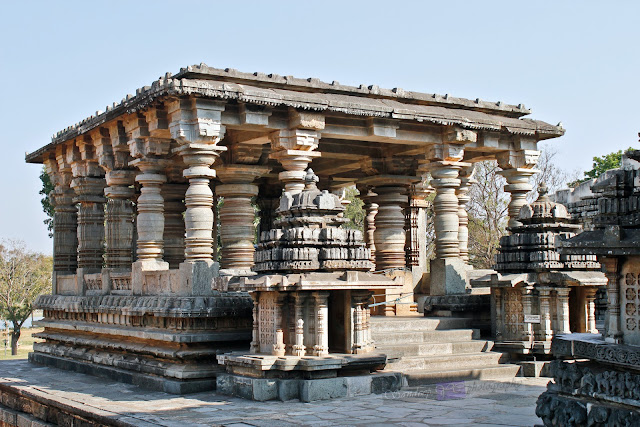
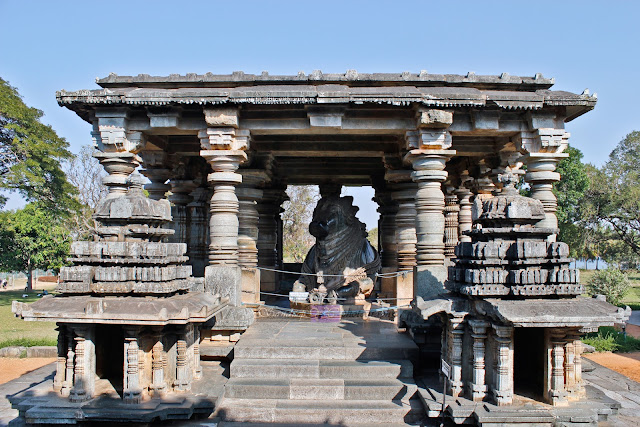
To the other side of the temple to the east are two more entrances facing to the Dwara Samudra Lake and to both of these east doors are the Nandi Mandapa's built with huge Nandi (the Bull, an attendant of Lord Shiva) statues inside it, being majestic in appearance and beautiful in composition. The walls on this side are more or less plain with less number of sculptures and pillars holding the roof structure and pierced perforated window structures are placed similar to that of the Belur temple.
Nandi Mantapa 1
Nandi Mantapa 1
The first Nandi statue from the north is of more importance and is more beautifully carved than the other. It has a plain mantapa with pillars and open to air without any walls, it doesn’t have a garbhagriha, but has model shrines on either sides of the Nandi mantapa.
Friezes on the base of the Nandi Mantapa 1, beside it is the Nandi Mantapa 2
Friezes on the base of the Nandi Mantapa 1, beside it is the Nandi Mantapa 2
Side view of the Nandi Mantapa 1
Pillars of the Nandi Mantapa 1
The more beautiful and ornate of the two Nandi statues at the Nandi Mantapa 1
The second Nandi mantapa is larger than the first one, similar to the first one it also has two model shrines on wither sides of the entrance and stands on a number of pillars with open structure, the only difference is this has a garbhagriha (sanctuary) with a beautiful Surya (Sun god) idol, carved out of black stone. The image of the Sun god Surya stands 7 ft. (2.1 m) tall.
Nandi Mantapa 2 with a shrine of Sun God behind Nandi statue
Pillars of Nandi Mantapa 2
Nandi statue at Nandi Mantapa 2, this was larger than the first one
Sun God statue Beautifully carved from black stone, it was totally dark inside the shrine
Sun God statue Beautifully carved from black stone, it was totally dark inside the shrine
An 8 feet tall sculpture of Ganesha including the platform rests at the south entrance, away from the temple platform.
Ganesha statue
Ganesha statue
Archaeological Museum of Halebid:
The museum was established in the early part of 1970’s. This museum has more than 1500 sculptures, architectural members; inscriptions of historical significance retrieve in and around Halebidu. The collection is displayed in a closed sculpture gallery as well as in an open air museum with a large reserve collection. It also display 18 ft. Tirthankara image from the ruined tank of one of the Jaina basadis.
Tall Jain sculpture at the museum
The open air museum has in its display many sculptures of importance like Govardhana giridhari Krishna, dancing Shiva, Nataraja and Veena Saraswati, dancing Ganesha, elegant couchant Nandi to name a few. The Sculptures of Brahma-Saraswati, Nagna Kala Bhairava, Mother and Child, wooden carvings and a bronze statue of a Tirthankara have been the important display in the sculpture gallery. The master pieces of this museum have represented Indian art in the various exhibitions held at France, Japan and other countries.

Opening Hours: 10.00 am to 5.00 pm
Closed on – Friday
Entrance Fee: Rs 5/- per head (Children up to 15 years free)

******************************************************************************** 

After visiting this temple one would have to imagine, how would have this temple be 800 years ago when it was constructed with its twin towers on top of the roof, it must be surely a marvelous structure, making it feel jealous for the foreigners to invade it twice, and many sculptures of the temple have been stolen and few of them taken to western countries, making it incomplete as its whole, otherwise the glory of the temple would have been enormous.


Though the temple was repeatedly ruined by the enemy kings of those days, I liked the whole temple being protected today by the government (or the Archeological survey of India), there were about 50 labors being employed for safe guarding the temple, and also they won’t even allow you to touch the walls of the temples, which should be pretty must appreciated. I personally feel they are the rare history of humankind and must be protected for generations to come; best way is to grant it as a UNESCO world heritage site for its rarest kind of man made marvels. If building huge structures is one kind of man made marvel then building a cutting edge quality structures carved entirely out of stones and lasting about 900years even after ruined by so many rivals, is another kind of man made marvel, some of them are so intricate that even with the present day machines it is pretty much difficult to even attempt to construct these kind of sculptures. Instead of granting world heritage sites for less meaningful and recently constructed structures, UNESCO should more concentrate on protecting the ancient structures in the process of protecting the history of mankind.


Kedareshwara temple and Parshwanatha Jain Basadi...To be continued...


Sunday, December 16, 2012

Pattadakal Virupaksha Temple – Bagalkot Heritage Drive - Day 2


Bagalkot Heritage Drive - Day 2 – Pattadakal Virupaksha Temple

We then went to Lokeshwar/Virupaksha Temple which is the most magnificent temple of the Chalukyan style built by Lokamahadevi, the Queen of Vikramaditya II in 740 A.D. in commemoration of his victory over the Pallavas of Kanchi. The architects of Pallava country built this temple; Anivarita Gunda was the chief architect. In fact this temple is believed to have been a model for the Kailasa temple at Ellora.
The temple is quite big with an area of 224ft & 105ft in length & breadth respectively. The temple consists of a garbhagriha, pradakshinapatha, mahamandapa, mukhamandapa & separate Nandi mandapa in front of the temple. The garbhagriha has a Dravidian type Shikhara of three tiers. The square garbhagriha has a highly polished Sivalinga on a square panipitha.

Virupaksha Temple
The most important part of the temple is the 18 pillars in 4 rows at the spacious mukhamandapa. They contain fine sculptures of Ramayana, Mahabharata & Bhagavata purana. There are also pictures depicting the Illusions. Poses of couples on pillars & the Series of amorous couples in various intimate poses. 
Mukhamandapa inside Virupaksha temple
Poses of couples on either side of the entrance
At the main entrance of the Virupaksha temple from the eastern porch, the inner ceiling with huge image of Surya, the god of the sun, is driven in his chariot across the heavens in this panel from the ceiling of the temple. This rather symmetric composition includes a radiant crown for the god; makaras disgorging smaller figures at his shoulders; Aruna ("Dawn"), his legless charioteer, at the bottom of the panel, holding the reins of seven horses representing the days of the week; a plethora of other divinities; & scalloped clouds (the usual convention) on either side. The archers standing by Surya's legs personify the light of Dawn, whose arrow-like rays dispell the darkness at the break of day.
Surya deva, driven in his chariot holding the rein of 7 horses
This temple is considered as one of the most important for Hindu scholars & Ancient Indian history. Also found here are the halegannada (Old Kannada) inscriptions
Halegannada Inscriptions
You can spend some meaningful time trying to unlock the stories of the sculptures on the pillars, each of the 18 pillars here have a different story to tell.
There are Guardian on both sides of the entrance, this nonchalant guardian's oversize club, as a martial art & form of exercise(shown left in the below pic). As an attribute, the club can belong to Shiva or Vishnu. Since the guardian holds aloft a snake in his right rear hand, his affiliation is undoubtedly to Shiva. Here is another guardian, with a different kind of club, in a somewhat relaxed if not quite so casual pose as his brother in the previous photo(shown right in the below pic).

Guardian on both sides
Also found here is Vishnu Trivikrama takes an acrobatic step across the universe. The temple, although dedicated to Shiva, also includes Vaishnava images such as this one. Harihara, with a trident-bearing gana on his right & Lakshmi(?) on his left. His left upper hand holds a conch. His right upper hand holds a worn attribute which looks suspiciously like a chakra, although this would not be correct for the "Shiva half" of Harihara. Shiva Ardhanarishvara is half-man & half-woman, here accompanied by a gana who seems astonished by the transformation. Also found are the sculptures of Narasimha, Durga Mahishasuramardini , Ravana lifting kailasa, Shankha Nidhi & Padmanidhi.
Scene from Ramayana and inscriptions in Kannada below that describing as Rama, Lakshmana & sita
Scene from the Mahabharata: Detailed scenes from the epics (Mahabharata & Ramayana) are carved on the pillars. The central band here may depict Bhishma lying on the bed of arrows (from the Mahabharata). During the fight his body was pierced with so many arrows that they supported him above the ground when he fell.
Scenes from Ramayana & Mahabharata
A decorated ventilator, thats supposed to be a single rope fashioned into a grill

monuments on the walls

Illusion 1 : all 3 dancers here share the leg and hand of one another when tried to cover the other two with ur hand you can see one full structure of a dancer

Illusion 2 : two different animals sharing the same face, on the right is elephant and on the left probably a horse or a bull.
There is a Nandi mandapa in front of the Virupaksha temple, which has a fine large stone bull which face the temple. The pillars here shows some sort of ornamental structures on it making it look more beautiful.
Nandi Mandapa
Nandi statue inside Nandi mandapa
Ornamental structures inside the Nandi mandapa


Bagalkot Heritage Drive - Day 2 – Pattadakal Papanatha Temple…to be continued…

Friday, July 27, 2012

Mysore weekend Tourism


Mysore weekend Tourism (A tourist hotspot):
One of the most visited places in Karnataka, and the most popular weekend getaways for Bangaloreans, with over 20 recognized destinations around Mysore. Some of these were visited on my visit to Mysore.
Mysore Dasara Exhibition

About Mysore:
Mysore the City of Palaces is a world famous destination having the most visited palace in India and 2nd most visited in the world, one of the largest Tiger reserve in the world - Bandipur also the vicinity. Not to mention it has the most popular Birds Sanctuary in Karnataka – Ranganathittu. The Mysore Zoo is one more place to look out for as the best in Karnataka. The most popular being the Dasherra/Dasara Festival carnival held In between Oct-Nov. With over 2.7 million annual visitors for Mysore Palace it is the most visited tourist destination in India after Taj Mahal.

Tourist places:
Ranganathittu, KRS Dam-Brindavan Gardens, Srirangapatna-Tippu’s summer palace-sangama-Nimishamba Temple, Nanjangud, Bandipur National Park, Nagarhole National Park, Mysore Palace, Chamundeshwari Betta/Hills, Mysore Zoo,.

Routes:
You need at least 3 days to cover some of these routes. The best route suggested from Bangalore is on day1 Srirangapatna- Ranganathittu -KRS and night halt at Mysore, on day2 Mysore palace-Zoo and Chamundeshwari hills and night halt near to Himad gopalswamy hills and day3 early morning visit to the HG hills to see the sunrise and later in the afternoon Bandipur for safari and then in the evening to Nanjangud and back to Bangalore.
Route 1: (2 days) Bandipur National Park, Nanjangud, and Himad Gopalswamy Betta/Hills
Route 2: (1/2 days) Nagarhole National Park
Route 3: (1 day) Srirangapatna, Ranganthittu, KRS
Route 4: (1/2 days) Mysore city-Palace-Zoo, Chamundeshwari Hills

Travelogue:
We had planned for a 2 day trip so we couldn’t cover Mysore Zoo and HG hills.
Day1: Bangalore-Srirangapatna Tippu’s Summer Palace-Sangama-Nimishamba-Ranganathittu-Brindavan Gardens-KRS Aquarium-Mysore Palace(Night Illuminated)-Chamundeshwari Hills-Night halt at Mysore.
Day2: Mysore-Nanjangud-Bandipur- Mysore Palace (Day visit inside the palace)-Bangalore

Day1:
River Kaveri, Nimishamba
We started our journey from Bangalore early morning thinking the traffic would be less, but for our surprise the traffic at 5-6am was hectic as it was a long weekend during dasara festival.
By the time we came out of Bangalore it was already 6am. And we halted at Maddhur for Breakfast at Maddhur Tiffin’s.
Maddhur is famous for breakfast in south India style with Maddhur vada/vade being the most popular in that region.
Gumbaz
Just after you pass by the river Kaveri over the bridge you need to take a left at Srirangapatna which is at a distance of 125km from Bangalore,
We started our first destination at Nimishamba Temple, which is on the banks of the river Kaveri at a distance of 3km from the highway.
The Place as should have been a very picturesque for being on the river banks but disappointingly it was not well maintained.


The Mausoleum Of Tipu Sultan 
Just a little further around 1.5km is Gumbaz/ The Mausoleum Of Tipu Sultan which has some nice views around.


We then moved to what is called as Sangama around 1km from Gumbaz, which is not the one near Mekedatu. This Sangama is not so scenic but worth a visit since it is just a 5min drive from Srirangapatna.
It is the place of union of 3 holy rivers Kaveri River, Kabini River and Hemavati River.

Daria Daulat
We then moved to Tippu’s Summer palace/ Daria Daulat (Best part of Srirangapatna) and had a decent time spent on the well maintained lawn’s. The palace has some old paintings of Tippu’s era.
The palace comes on the way back towards the Highway around 3.5km from Sangama.
Tippu’s Summer palace
All these places come on the left side of the Blore-Mysore State Highway, all these places fall at less than 5km in distance with each other so can be covered in 2-3hrs.
One can visit Ranganatha temple which is on the right side of the Highway and is the most popular destination of Srirangapatna.


Ranganthittu Park
Way back to the highway took left towards Mysore and we then we could see a boarding written as Ranganthittu Bird Sanctuary which falls on the right side of the Highway. You should take the KRS road on the right and further moving on the KRS road there is one more diversion on the right towards Ranganthittu; it is just around 5 km from the Srirangapatna junction. Ranganthittu is a decent place to spend some good relaxed time with the family.

Ranganthittu Bird Sanctuary
There is a well maintained park area in the entrance where u can relax or even have your homemade food on the places provided for having food. Also there is a large car parking area.
We had our lunch here which we got from home, and then started to walk towards the river where you get some spot different species of birds, most popular over there being River tern, Black headed Ibis, Painted Stork, Open bill Stork and also this place is famous for Crocodile, so playing in water is banned here but one can go in a boat ride provided from the Karnataka Tourism.


Crocodile
River Tern
Boating at Ranganthittu
Though the boats are big in size they are not motor boats reason being to maintain silence for the birds around and to have a smooth ride around the birds. The major drawback of this being no life jacket provided, even though it is maintained by the Government. 
Apart from the views from the boating you can also explore the river and the birds by going along the riverside with plenty of watch towers built along the river banks. 


Bridge towards KRS
You've to come back around 600m to reach the KRS road and then take right towards KRS on the KRS road. KRS is around 25km and takes 1hour drive from Ranganthittu and spent some good time watching the lawn and the fountains. 

Once you park the vehicle you can take the right side through the Ferry for Musical Fountain or can walk on the bridge, and KRS dam and Brindavan Gardens on the left side. There is also an Aquarium near the parking place which is worth a visit. 


Chamundeshwari hills
We then moved towards Chamundeshwari hills which is around 35kms from KRS and there are 3 routes to reach the hill from KRS, we took the Hunsur Road. On top of the hill is Sri Chamundeswari Temple and once you take the route down you come across a Huge Nandi statue carved out of single stone. 


We then came down the hill and visited Mysore Palace to have a night view with lights illuminated. Later in the night we halted at Mysore.


Day2:
On the day 2 we started our day with Bandipur in the morning which is around 80km from Mysore, though not so great for safari but a decent one. On safari you can spot Wild boar, Elephant, deer, Gaur, Peacock and Langur in large numbers. The place is one of the largest Tiger reserve in the whole world, it stretches 874sq km. Might be it is quite conserved for limiting the safari only to the nearby places and not in the deep jungle, so quite a lot of big cats and wild animals were not visible.  As per the Forest department The numbers are among the big cats there are over 75 Tigers and 88 Leopards in Bandipur reserve Forest, and the numbers are healthy when it comes to Elephants at over 3,500 and Gaur around 2,500. Though the major part of the forest is covered from Chital and Sambar.
Karnataka houses the highest number of Tiger Reserves in India, which includes Bandipur, Dandeli, Bannerghatta, Kudremukh, BR hills, Bhadra, and Nagarhole.


We then moved towards Nanjangud which was very attractive and well maintained temple at the banks of the river Kabini/Kapila. It is around 55km from Bandipur towards Mysore. Major attraction over there is Srikanteshwara Temple, there is also a big Shiva statue newly built at the place. 


We then moved towards Mysore and had lunch at kamat in the outskirts and the last place to be visited was kept preserved to be seen in the end of the trip. As it was said Mysore Palace is the 2nd most visited Palace in the whole world it was surprisingly the best place to visit and a place not to miss in one’s life. Mysore Palace, rated as one of the 31 must-see places on Earth by New York Times. In 2010, Mysore Palace had a domestic visitor footfall of 3.1 million and another 70,000 from abroad. Well the place was so awesomely beautiful that it can be described only by seeing it from your eyes. As it was heavily crowded but still didn’t disappoint with its mesmerizing wall paintings and the royal doors and windows. Bottom-line is you must have seen it from outside but see it from inside to get to know why it is so popular. Camera’s and footwear are not allowed inside the Palace so one have to get a locker at the entrance to keep them inside the locker and visit the palace bare foot with hands free from your camera. Photography is strictly prohibited inside with CCTV’s watching you from every corner, don’t make a mistake by taking a pic from your mobile as you’ll be easily caught and taken into custody from the security personnel’s.
With the most delightful views for the eyes which last for a long time, we ended our journey back to Bangalore.